
Listening to NPR this week about women lacking self-compassion, I was reminded again why I wrote my memoir Again in a Heartbeat. The memoir, a novice’s attempt at this complicated and compelling genre, was a path to atonement for not being a better wife to my late husband, John, at the end of his seven-year battle with terminal cancer. When a book club hosted me last week after selecting Again in a Heartbeat as their monthly read, I repeated, as I have many times over the years, that writing the book helped me forgive myself.
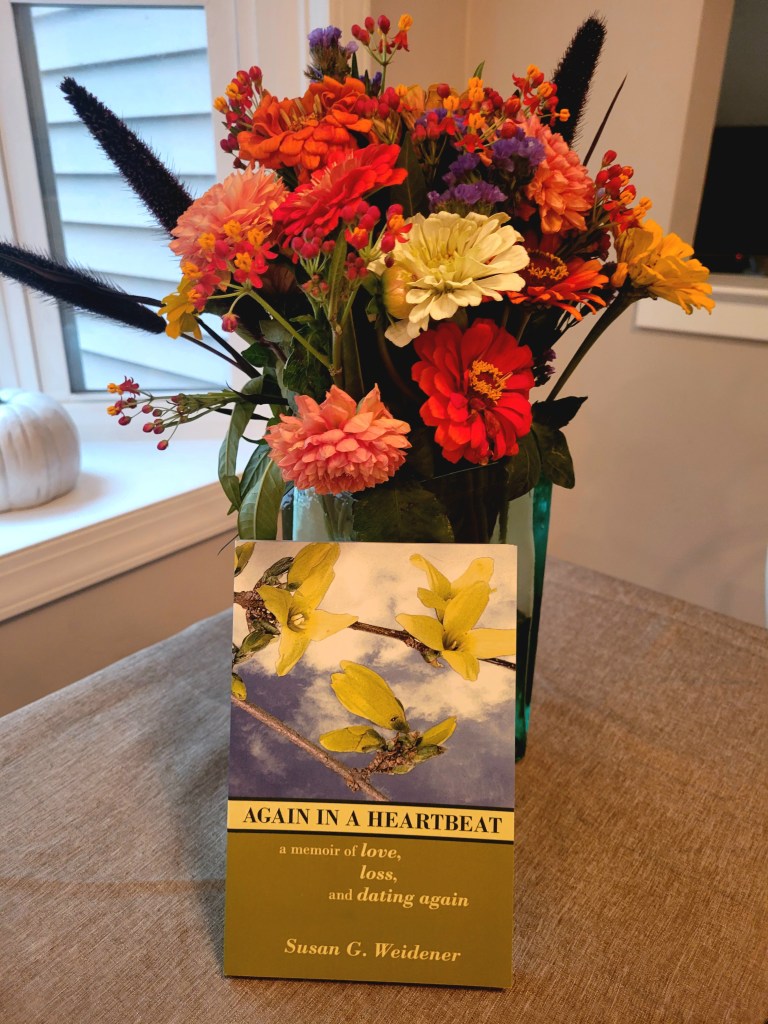
One woman commented that after reading the book she didn’t like me and “I struggled with that and wanted to shake you for not being nicer to him.” That led to sharing how loss affects us. It’s okay to be human. Not all of us perform perfectly or even close to it in trying times, especially when watching someone you love die. Although I wrote the book in 2010, the fact that it still resonates all these years later brings joyfulness that John’s memory lives on.
Why are women so hard on themselves? Why do we often feel compassion for everyone but ourselves? Why do we nurture others, but not ourselves? How does the inner critic come into play here? The inner critic is only so good when, instead of beating yourself up with criticism, you can use it to learn more about yourself and, hopefully, avoid similar missteps in the future.
One of the things I love about this topic of self-compassion is when women realize that men are easier on themselves than women. Men tend to compartmentalize events and then move on, whereas, for women, one memory—often one that is negative—stays with us while all the good things we did for that person slip away. I remember so vividly that day in the kitchen, me yelling at John, “I wish I’d never met you!” rather than focusing on the fact that I gave him two beautiful sons and remained faithful to the end. I think, too, I brought beauty and romance to our lives and became, as he once said, “My dream come true” meaning having a wife and family.
Today would have been John’s 76th birthday. He’s been gone twenty-nine years but still, that one memory can replay in my mind when I least expect it. It serves as a touchstone to my shattered dreams and my naive expectation that I could control everything and enjoy a long and happy marriage. With this hope gone, I lashed out. I spent years feeling ashamed of that moment.
Writing as a way of healing has been close to my heart and I’ve written a lot about it including how writing is not only a great healer but a great companion and teacher. At the book club, we discussed that a creative life offers mindfulness and the inspiration to imagine a better world and life for ourselves and others. Writing helps you pay attention to detail, slow down, take that deep breath, and ask the quintessential question: Who am I? It helped me forgive myself, nurture myself, and be proud that I could love as deeply as I did.

As Louise DeSalvo writes in Writing as a Way of Healing when Virginia Woolf wrote her memories, she “soon began exploring some difficult feelings—what she called her looking-glass shame and seeing her reflection made her feel worthless.” Woolf traced this back to when as a child she was afraid or ashamed at seeing her body in the mirror. Eventually, she tied this to the memory of how when she was six or seven she was sexually assaulted by her brother.
The healing narratives we write offer a chance to better understand ourselves and what came before as a blueprint for moving forward. We are forging a more self-compassionate relationship with ourselves … moving on and triumphing over adversity. Writing is a mirror. It reflects trust and acknowledgment of difficult circumstances and that we are not alone.


It is so true, as you say, that men and women have very different ‘self-talk’ settings. I have four younger brothers and I doubt that one of them has given more than a minutes thought to any falling out amongst the five of us. But me on the other hand … oh dear.
LikeLike
Thank you for sharing that, Margaret.
LikeLiked by 1 person
I agree that writing teaches self-compassion. Every time I sit down at my writing desk, I acknowledge to myself that I have something to say. Something that is worth listening to. Reading my work aloud to the women in our Writing Circle helps to reinforce this sense of self-worth.
LikeLike
Thank you, Marilyn. Your writing always strikes a chord in the Circle. And I agree that when we write and others listen, it validates us and our voice. Let’s all keep writing!
LikeLike