
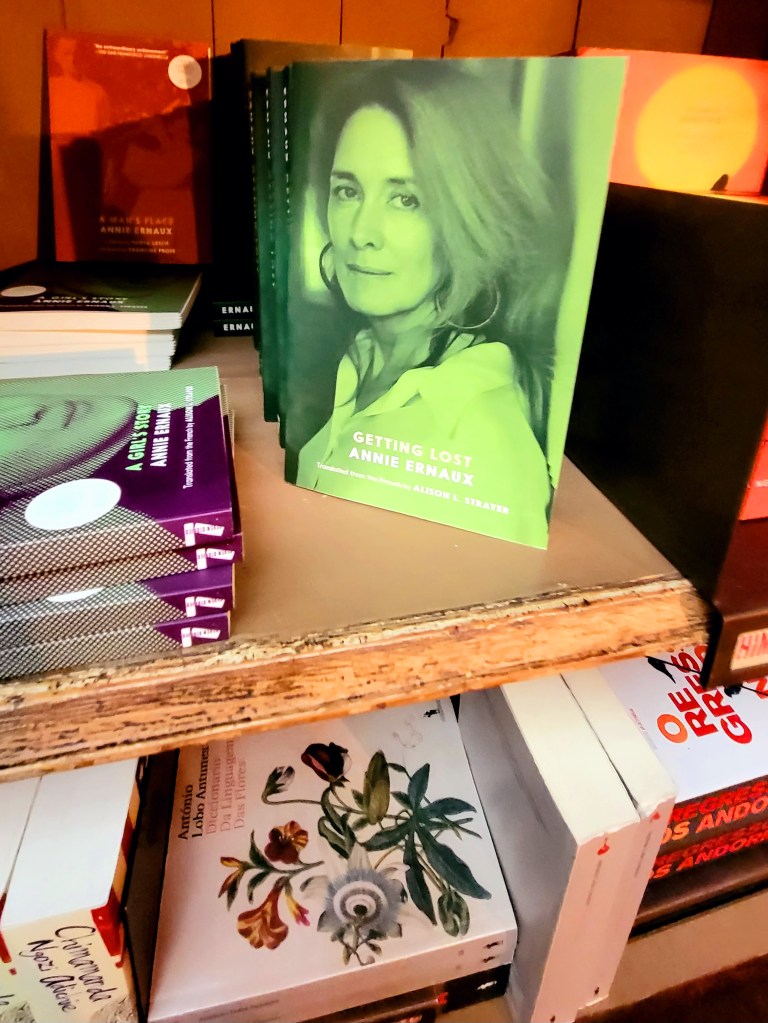
In Portugal, I visited the famous Livraria Lello, a world-renowned bookstore, and wrote about it here. A book that caught my eye was Getting Lost by the French author Annie Ernaux. I had never heard of her or that last year she won the 2022 Nobel Prize in Literature. Still, as I flipped the pages, I was instantly captivated by her description of a man leaning up against the wall, a little drunk, a man who while she understood his dark side, she remained obsessed with. My feeling was I’d known this man, too.
When I returned home, I checked Getting Lost out of the library. Getting Lost is Ernaux’s memoir written in journal form about the year-and-a-half affair she had with a married man, a Russian diplomat with whom she was obsessed.
Page after page, chronicled by the days and weeks of her life, Ernaux waits for his visits, at all or any hours of the day or night. When he calls, her life becomes alive again fueled by erotic obsession. Filled with self-loathing at her dependence on him, and her passion for him, her journal becomes her companion, her therapist. As her misery and anxiety fill page after page, I find myself losing patience with her. Why was a forty-eight-year-old mother of two grown sons so dependent on a man? After all, she was a famous and well-respected writer in literary circles. Wasn’t her writing enough?
Yet hadn’t I been the same way when I was forty-eight, obsessed with a man after my husband died and had an affair that sparked me to write about it in my memoir Again in a Heartbeat? Who was I to judge her?
It is this vulnerability that we offer as memoirists that is our act of love for our readers. Like Ernaux who was ridiculed for writing exhaustively of her dependence on this man—waiting in vain for phone calls that never came—I, too, had been treated with disgust by some of my readers for opening up about how I felt I could have been a better wife at the end of my husband’s life and so raced to find an immediate replacement for him. It was that sense of shame, as well as my desperation not to be alone that drove me to a man who turned out in the end to be much like Ernaux’s lover. Narcissistic, yet strangely fascinating, he struck a chord in me to such an extent that he was often all I could think about…not my work as a reporter at a daily newspaper, but him.
Just what is obsession? How is it linked to fear of abandonment? Ernaux flashes back to the death of her mother and to her abortion as a way of connecting abandonment to obsession. As we all learn, obsession is unhealthy, often evidenced in a toxic relationship that reduces a woman to a demeaning posture and the terrible description of “being a doormat.” As Ernaux waits for her lover’s calls, she knows that rejection is inevitable. He has options (he has a wife and there are younger women), and his work.
As a woman ages, she faces the terrible prospect that he may be her last lover, she writes. Who wants an old woman? He can replace me any time he likes with another woman, a younger woman, she thinks. Aging as a woman alone offers up the specter of abandonment, of solitary loneliness.
Ernaux’s obsession turns to neurosis. “I’m living in a stupor. My strongest premonition: he won’t be at the embassy tonight (because he’s left France, or is traveling —or because he doesn’t want to come, but why wouldn’t he?). Another possibility is that he’ll show indifference and not fix a meeting with me. Or: he will want to see me. But these thirteen days with no word from him leave me little hope of that. Yet right now I don’t know anything. In two and a half hours, it may all be over. My last letter will remain in my handbag. It always feels like a kind of death.”
Much has been written about the benefits of being vulnerable with our writing. Not only is it forging an intimate relationship with our readers, but it also allows for our own self-healing and self-awareness. Although it opens us to criticism and judgment, honesty and good writing go hand in hand. Artifice is quickly sorted out by the reader.
Ernaux confronts the futility of it all, the hope to salvage some shred of dignity in the end. After all, she is a writer. Writing is a survival tool that keeps death at bay. And she has the vulnerability to connect with her readers, a gift of love, but one that also takes great courage. However painful a read Getting Lost may be, it brought back this truth—writing takes courage, vulnerability, and the ability to face our own demons.


It does! Thank you, Marilyn, for sharing this insight.
LikeLike
I love Annie Ernaux, or what I have read. She’s very brave and helps make us brave too as memoirists. Brave of you as well, to reluctantly identify. I’m sure we all do.
LikeLike
Thank you, Margaret. I agree she helps memoir writers take the plunge and let it all hang out, so to speak. When I did it, it was dipping a toe into unknown waters. Ernaux took a full dive with Getting Lost.
LikeLiked by 1 person